









Always in sync, even across episodes
No more "wait, let me pause" moments. Our sync engine keeps everyone frame-perfect—even when you binge multiple episodes in one party.

Start playing any video on Netflix, Disney+, or 10+ supported platforms.
Click the Flickcall logo on top right once video starts or hit the Flickcall icon on chrome toolbar. Your watch party is ready in one click.
Copy the party link and send it to your friends. They join with one click—no sign-up required.
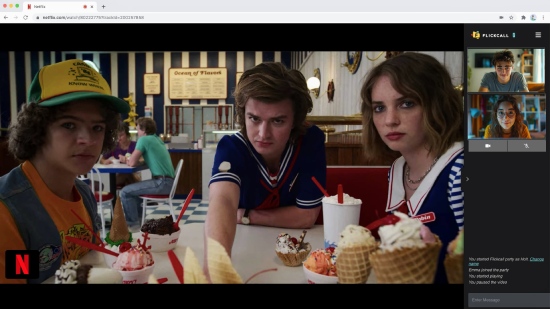
Create watch parties on Netflix, Disney+, JioHotstar, JioHotstar, HBO Max, MAX, Hulu, Prime Video, Youtube, Zee5, Sony Liv, JioHotstar with Flickcall.

No more "wait, let me pause" moments. Our sync engine keeps everyone frame-perfect—even when you binge multiple episodes in one party.

Catch your friends gasping at plot twists. Share laughter in real-time. Video chat makes every watch party feel like you're on the same couch.

Install the extension, play any video, click the Flickcall icon. That's it—share the link and you're watching together.
When you pause video, your mic unmutes. When you play, it mutes. Smart Mic knows when you need to talk. No fumbling with buttons, just natural conversation.

We use peer-to-peer technology to connect you directly with your friends. Your video calls and chats are never routed through our servers unless direct connection is blocked*.
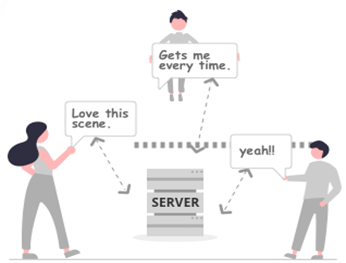
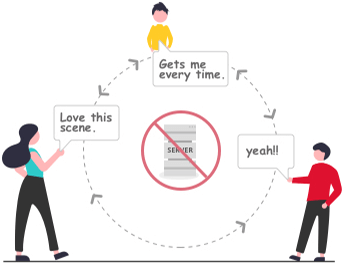
* In some cases, firewall setting doesn't allow direct connection, the calls and messages are encrypted and transmitted via routing servers.
Epilogue: Shadows as Mirror To look at the phrase “TamilGun verified” is to look at a mirror of modern media’s frictions. It reveals a contested topology where technology, commerce, culture, and ethics intersect. The shadow’s edge traces both failure and ingenuity: failures of formal distribution systems, and ingenuity in the ways people circumvent or adapt to those systems. Whatever the lawbooks decree, the presence of such names forces a reckoning—about who gets to see, who pays, and how societies value artistic labor versus cultural access.
Moral and Human Costs The chronicle must account for human texture: a filmmaker whose premiere is undermined by a leak; a cinema owner whose weekend line disappears; a worker in post-production who sees months of labor surface online. Conversely, there is the student in a remote town who first encounters a life-changing performance because of that same leak. The shadow contains both predation and relief; it complicates any simple moral calculus.
The Language of Stigma and Resistance “TamilGun verified” functions as both brand and code. For some, it signals illicit consumption; for others, it signals solidarity against gatekeeping. Public discourse around piracy often masks deeper conversations about accessibility, affordability, and cultural inclusion. The stigma attached to piracy coexists uneasily with resistance that frames access as a right and distribution as a structurally biased market.
The Architecture of Evasion The operations that surround such a name are diffuse by design. Domains rotate; mirror sites appear and vanish; links propagate through private chats and ephemeral platforms. Actors—some opportunistic, some organized—exploit technical affordances: distributed hosting, peer-to-peer protocols, and the opacity of the global content-distribution lattice. These technical measures create friction for enforcement efforts and a kind of techno-anonymity that reinforces the “shadow” in the name.
Origins and Gravity TamilGun began, to many, as a simple signpost: a torrent title, a website banner, a search query returning newly leaked regional films and dubbed releases. For viewers starved of immediate access—across diasporas, regions with delayed theatrical releases, or places where distribution quietly discriminates—the site read like a loophole in the global gatekeeping of culture. The name carried a promise of immediacy and availability; it became a magnet for collective need, a repository where demand met supply outside official channels.
Epilogue: Shadows as Mirror To look at the phrase “TamilGun verified” is to look at a mirror of modern media’s frictions. It reveals a contested topology where technology, commerce, culture, and ethics intersect. The shadow’s edge traces both failure and ingenuity: failures of formal distribution systems, and ingenuity in the ways people circumvent or adapt to those systems. Whatever the lawbooks decree, the presence of such names forces a reckoning—about who gets to see, who pays, and how societies value artistic labor versus cultural access.
Moral and Human Costs The chronicle must account for human texture: a filmmaker whose premiere is undermined by a leak; a cinema owner whose weekend line disappears; a worker in post-production who sees months of labor surface online. Conversely, there is the student in a remote town who first encounters a life-changing performance because of that same leak. The shadow contains both predation and relief; it complicates any simple moral calculus. the shadows edge tamilgun verified
The Language of Stigma and Resistance “TamilGun verified” functions as both brand and code. For some, it signals illicit consumption; for others, it signals solidarity against gatekeeping. Public discourse around piracy often masks deeper conversations about accessibility, affordability, and cultural inclusion. The stigma attached to piracy coexists uneasily with resistance that frames access as a right and distribution as a structurally biased market. Epilogue: Shadows as Mirror To look at the
The Architecture of Evasion The operations that surround such a name are diffuse by design. Domains rotate; mirror sites appear and vanish; links propagate through private chats and ephemeral platforms. Actors—some opportunistic, some organized—exploit technical affordances: distributed hosting, peer-to-peer protocols, and the opacity of the global content-distribution lattice. These technical measures create friction for enforcement efforts and a kind of techno-anonymity that reinforces the “shadow” in the name. Whatever the lawbooks decree, the presence of such
Origins and Gravity TamilGun began, to many, as a simple signpost: a torrent title, a website banner, a search query returning newly leaked regional films and dubbed releases. For viewers starved of immediate access—across diasporas, regions with delayed theatrical releases, or places where distribution quietly discriminates—the site read like a loophole in the global gatekeeping of culture. The name carried a promise of immediacy and availability; it became a magnet for collective need, a repository where demand met supply outside official channels.