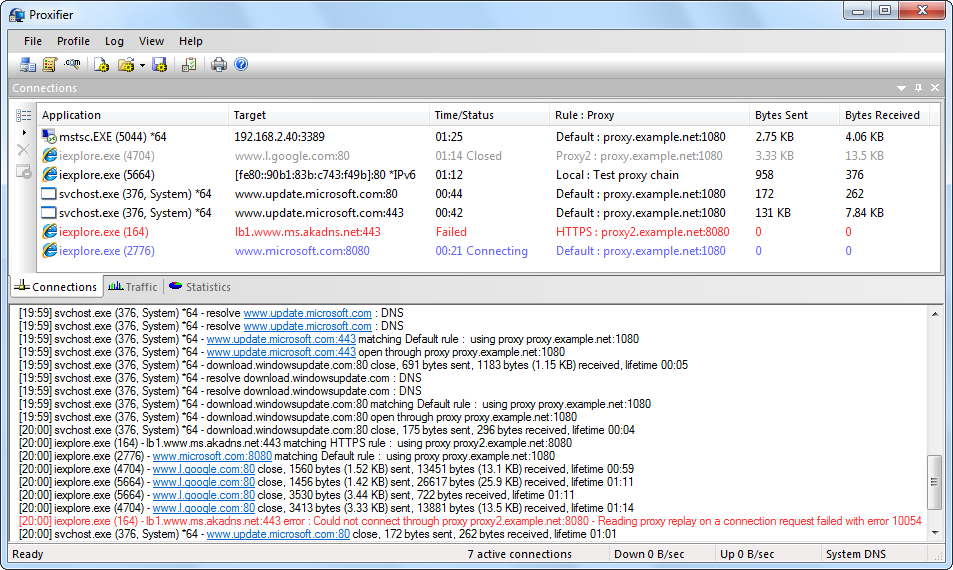
Redirect connections of any internet app (browser, email, database, game, etc.) through a proxy.

Control access to resources. Route all your connections through a single entry point. Update multiple configurations remotely from a single place.

Route internet traffic through faster routes.

Lightweight and flexible alternative to VPN. Tunnel your connections through encrypted channels.

Use a proxy as a gateway for your internet activities.

Assign different proxies or chains to different connections using the rule-based system.
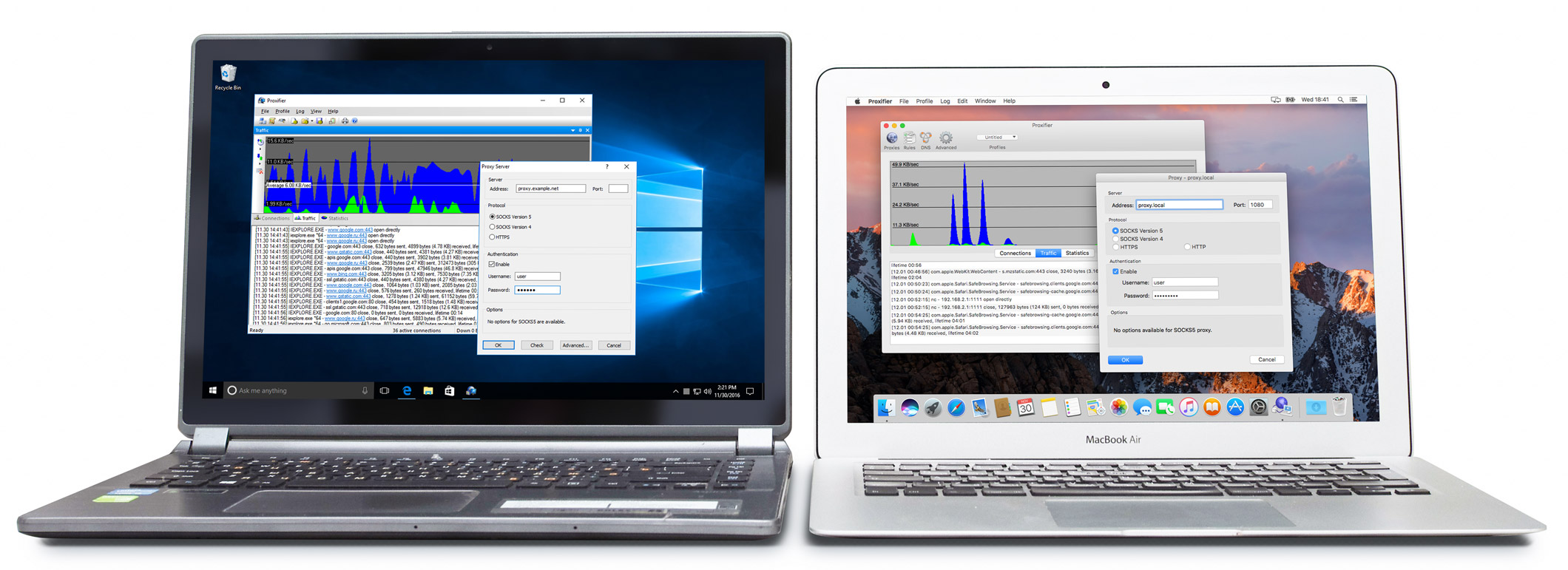
Proxifier is always up to date with the latest OS versions of Windows, macOS and Android.
IPv6, HTTP(S), SOCKS, DNS via Proxy, Proxy Checker, NTLM, Windows Service, XML Config, Proxy Redundancy.
Native C++ app. No third-party dependencies. Installer size is 4 MB.
Transparent handling of connections on the system level. Best-in-class compatibility with third-party apps.
In a corporate network of 500 computers, Proxifier is deployed to forward connections through the proxy. The configuration gets managed remotely from a single control point.
A gamer from Asia has connectivity problems when playing on a US server. With Proxifier, he optimizes the routing with a chain of proxy servers.
A user needs to load-balance connections across multiple proxies. Proxifier can do this and also provide an automatic fallback if proxy is down.
Remote workers and road warriors use Proxifier as a lightweight alternative to VPN. Flexible rules allow tunneling of selected apps and targets.
A user needs to encrypt traffic for an app that does not support SSL. Proxifier forwards traffic though an SSH or SSL tunnel.
A support team needs to control the availability and performance of a service in multiple distant regions. With Proxifier, they easily switch between multiple proxies to simulate a local presence.
In a way, sfvip’s closure was a tiny calibration of mortality. Everything that ends triggers a cataloguing of what had been, a selection of which memories to keep. The player’s mechanical authority made that cataloguing less ambiguous: it allowed the soft things to be counted. It also taught an odd patience. People discovered that endings could be observed rather than solved—felt rather than fixed. In the hush after playback finished, it was permissible to sit with ambiguity, to let questions hover without pressing them into immediate answers.
Technology is supposed to be a servant of narrative, a tool that records and replays the lives we lead. Yet there was something almost ceremonial about the way sfvip pronounced the end. It was as if the player had authority to confer completion—that the machine’s tiny, indifferent voice could validate grief, authorize memory, and, in its own limited way, make meaning. In that deeming, there was a danger and a grace: a danger because machines can flatten complexity into binary states—played/finished, on/off—losing the messy intervals between; a grace because sometimes the world needs someone, or something, to declare that a chapter is done so the next one may begin. sfvip player playback finished
For the creator of the piece—who once stayed up through the night shaping a monologue into a melody of pauses—the final click was an exhale. It meant the work had run its course, that the sequence of choices had been honored from first frame to last. For a child who watched the credits scroll and then toddled away to bed, it meant only that bed-time stories were now permissible. For a stranger on a different continent, it might mean, peculiarly, the resolution of an argument they had been having with themselves over whether to leave a job or stay. These divergences illustrated something human and stubborn: a single ending can multiply into a thousand small, private beginnings. In a way, sfvip’s closure was a tiny