

[Click here for a key to the symbols used. Some county routes were constructed with federal funds. These routes are indicated as FAP (Federal Aid Primary), FAU (Federal Aid Urban), or FAS (Federal Aid Secondary). If no funding source is shown, no federal funds were used. Note that while some segments seem to have the same attributes, they may differ in the county-local road number assigned to the segment, or in the Caltrans Map Sheet number.]
 Routing
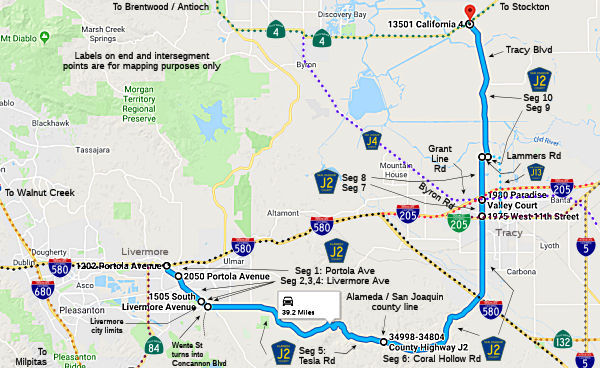 Portola Avenue from I-580 to the Livermore city limits (FAU, 0.72 mi) [Alameda County]
Livermore Avenue in Livermore (FAU, 1.25 mi) [Alameda County]
S Livermore Avnue from the Livermore city limits to Wente Street
Concannon Blvd (FAU, 0.75 mi) [Alameda County]
S Livermore Avenue from Wente Street Concannon Blvd
to Tesla Road (FAS, 0.54 mi) [Alameda County]
Tesla Road from S Livermore Avenue to the San Joaquin county line (FAS, 12.21 mi) [Alameda County]
Corral Hollow Road from the Alameda county line to Byron Road (FAS, 12.05 mi) [San Joaquin County]
Corral Hollow Road from Byron Road to Grant Line Road (County Sign Route J4) (FAU, 0.85 mi) [San Joaquin County]
Corral Hollow Road from Grant Line Road (County Sign Route J4) to Lammers Road (FAS, 2.65 mi) [San Joaquin County]
Lammers Road from Corral Hollow Road to Tracy Blvd (FAS, 0.30 mi) [San Joaquin County]
Tracy Blvd from Lammers Road to Route 4 (FAS, 7.90 mi) [San Joaquin County]
 History and Signage Information
They say a single line of characters can change everything. A string of letters and digits, a small sequence you paste into a box, is the hinge between a closed door and an entire universe of possibilities. “Serial key” sounds technical and mundane—yet behind that clipped phrase lies drama: the tug-of-war between access and restriction, creativity and control, curiosity and commerce. The little code that gates the great things At first glance a serial key is a license token: proof you paid, permission to install, a pass to advanced features. But it’s also a symbol. It represents trust traded for value. For developers, it’s the blunt instrument that funds upkeep and pays the team. For users, it’s the promise that software will behave beyond a trial or watermark. Where generosity and greed meet, that small string becomes a battleground. How one key rewrites an ordinary day Imagine this: a student, exhausted after months of juggling deadlines, finally finds the premium statistics package that will let them finish a thesis. One purchase, one serial key later, and the analysis that stalled for weeks resolves into neat graphs that sing. Or picture a tiny studio whose indie game languished behind obscurity until a distribution platform accepted it—suddenly the team types in their activation key and the world can buy, play, and prop open the door to fame.
In a healthier future, the serial key will feel less like a lock and more like a welcome mat—strong enough to discourage abuse, generous enough to invite participation, and designed so that unlocking truly opens the world rather than shutting parts of it away. A handful of characters can gate software; wise choices about how we use them can gate nothing at all. The real power of a serial key is not the code itself, but the values embedded in the systems that issue and accept it—values that decide whether unlocking leads to hoarding or to horizons. serial key unlock the world
A serial key can unlock relief, opportunity, livelihood. It grants agency to creators and consumers alike. Of course, there’s an underside. The same code that authorizes can be stolen, shared, and cracked. Piracy undermines sustainable development; cracked keys and shared generators blur the line between rescue and theft. Companies respond with stricter checks—online activation, hardware locks, opaque telemetry—and users chafe at perceived surveillance. The serial key becomes a proxy in a broader argument: how to balance protection of intellectual property with fair access and user rights. The cat-and-mouse of protection Technology has pushed licensing through many stages: static keys in boxes, online activation that phones home, hardware dongles that troll for ports, and now cloud entitlement systems where your “license” lives on a server you don’t control. Each advance raises the bar for pirates but often raises friction for legitimate users. The clever workaround prompts yet another countermeasure. It’s not merely a technical contest—it's a social one, where law, ethics, and economics crash into each other. A humane approach The most enduring systems treat serial keys not as chokepoints but as bridges. Flexible licensing—trial periods, tiered pricing, student and educational discounts, time-limited subscriptions—acknowledges differing needs and budgets. Open-source models, freemium approaches, and community licensing experiment with alternative value flows. When companies center trust and fairness, activation becomes part of a relationship, not a gauntlet. Beyond the string: unlocking the world Ultimately, “serial key: unlock the world” is an invitation to reconceive what we mean by unlocking. It’s not only about bypassing paywalls or cracking codes. It’s about deciding who gets entry to tools that amplify voices, who can afford the instruments of creation, and how society funds the labor that builds the digital scaffolding of our lives. They say a single line of characters can change everything
 National Trails
 This route is part of the De Anza National Historic Trail.
 Other WWW Links
 Status
Total mileage: 39.22 mi.
© 1996-2024 Daniel P. Faigin.
Maintained by: Daniel P. Faigin
<>.
 CR J1
CR J1 CR J3
CR J3