Paradisebirds Anna Nelly Page

Professional Traktor to Pioneer CDJ/XML Converter

Bridge the gap between Traktor's superior playlist management and Pioneer's CDJ ecosystem with complete metadata preservation and intelligent file management.

✓ Extended Hardware Compatibility: Traktor Bridge supports legacy CDJ models including the CDJ-2000NXS2, helping DJs maximize their existing equipment investment even as newer software standards evolve. Continue using professional hardware that meets your performance needs without forced upgrades.

Created with passion by Benoit (BSM) Saint-Moulin
© 2025 - Free & Open Source

The Problem Every Traktor DJ Faces

✓ Traktor Bridge 2.0 try to solves this - preserving many years of organizational work while enabling CDJ compatibility in minutes, not hours.

Why Choose Traktor Bridge 2.0?

A utility that is both simple and complete, converting Traktor Pro playlists and music collections into formats compatible with Pioneer CDJ and XDJ.

Smart Conversion

Automatically detects Traktor Pro versions (3.5.x and 4.x) and converts to Rekordbox database (.pdb) or XML format with complete accuracy.

Complete Data Preservation

Preserves all metadata, BPM, musical keys, cue points, loops, beat grids, and album artwork. Your organizational work stays intact.

Intelligent File Management

Smart path resolution, automatic relocation of moved files, and selective playlist export. Handles large collections efficiently.

Audio Preview & Timeline

Real-time audio preview, cue point timeline with graphical visualization, and integrity verification before export.

Advanced Architecture

Secure multithreaded processing, complete error management, and real-time progress tracking for professional reliability.

No Programming Required

Intuitive graphical interface guides you step by step through the entire conversion process. No technical expertise needed.

See It In Action

Professional interface designed for DJs who want results without complexity

Main Interface Screenshot

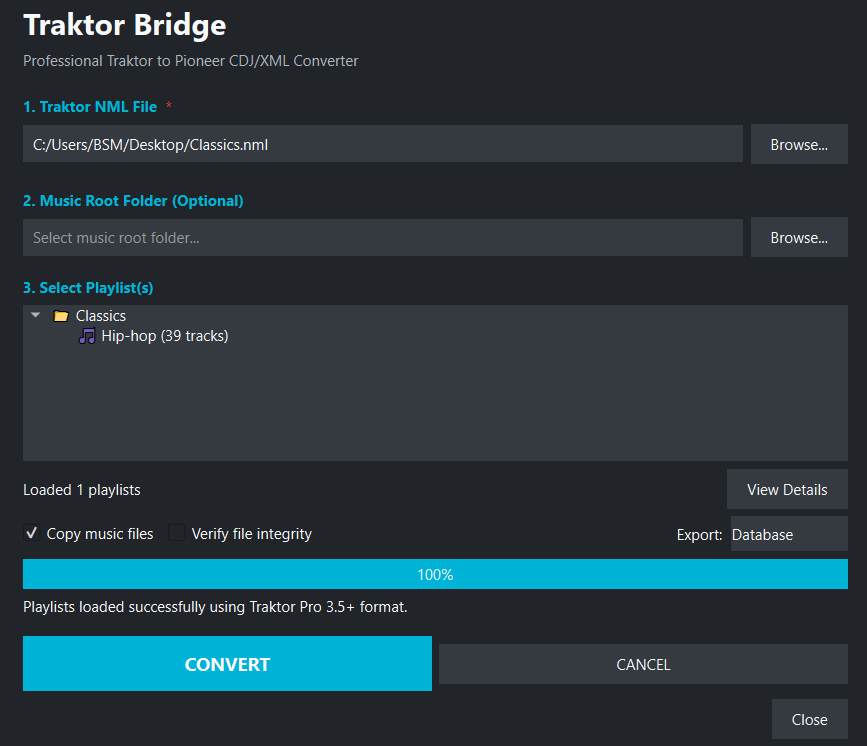
Intuitive Main Interface

Clean, step-by-step workflow that guides you through the conversion process. Modern dark-themed design with clear navigation between playlist selection, option configuration, and conversion launch with real-time progress tracking.

Track Details & Preview

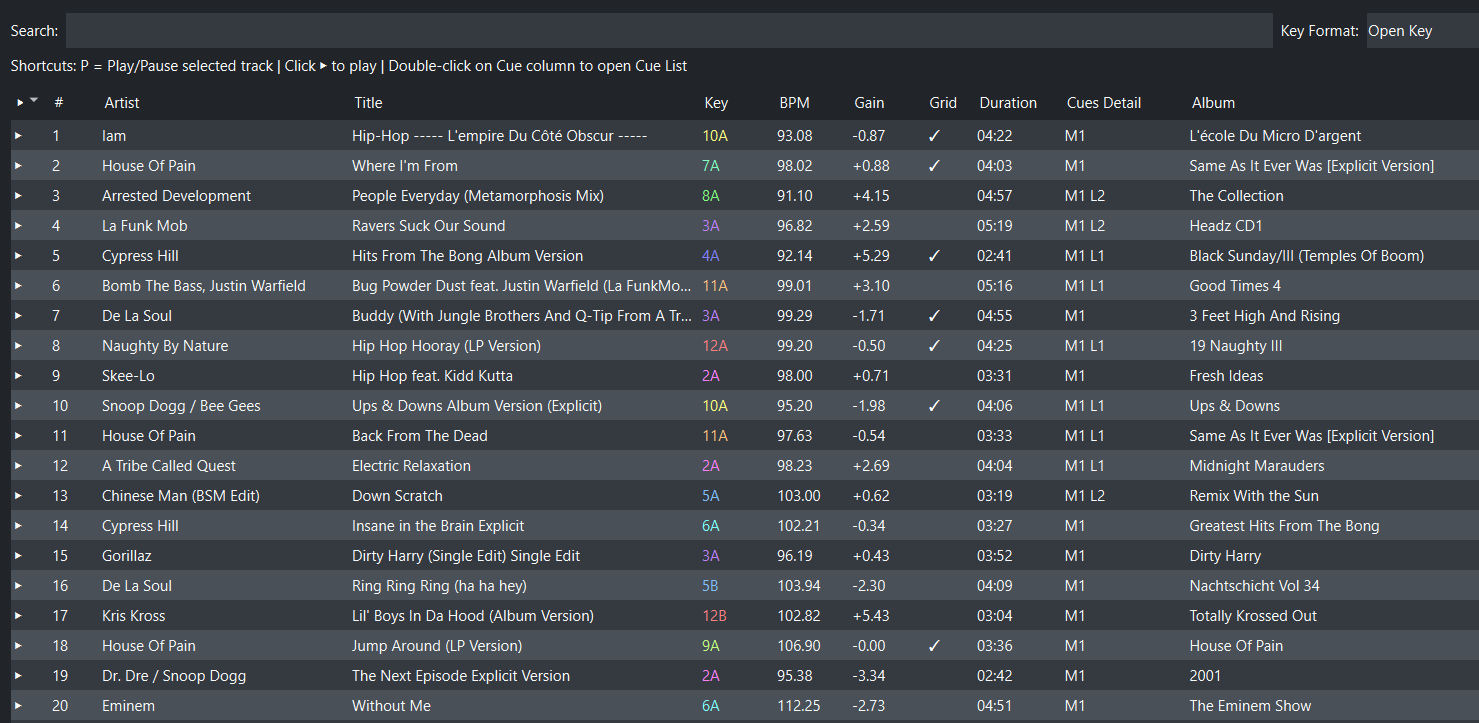
Track Details & Audio Preview

Preview tracks, visualize complete metadata including BPM, musical key (Open Key format), and detailed track information. Professional interface with comprehensive track library display and search functionality.

Cue Point Analysis

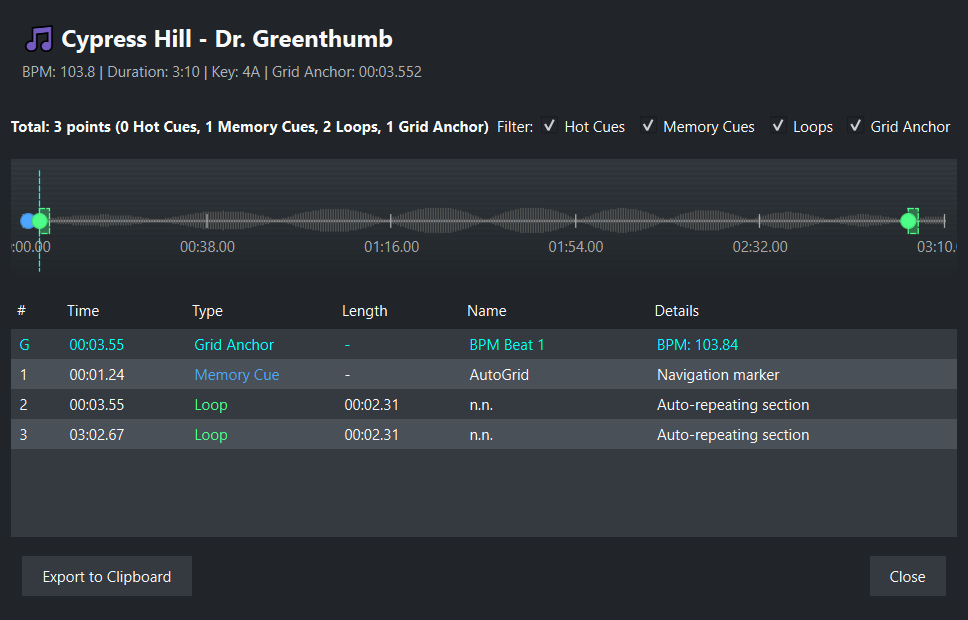
Cue Point Analysis Timeline

Visual timeline showing cue point analysis and verification process. Interactive graphical representation of cue points, loops, memory cues, and grid anchors with precise timing information.

Complete Feature Set

All the features you need for professional conversion

Automatic Traktor version detection
Support for Traktor Pro 3.x and 4.x
Export to Rekordbox XML and PDB
Complete metadata preservation
BPM and musical key conservation
Cue points and loops transfer
Beat grid preservation
Album artwork conservation
Intelligent path management
Selective playlist export
Integrated audio preview
Graphical cue point timeline
Data integrity verification
Complete error handling
Cross-platform compatibility
Multiple audio format support

Universal Compatibility

Supports all major audio formats and works with your existing hardware

Audio Formats

MP3 WAV FLAC AIFF M4A OGG

Key Notation Systems

Open Key (Camelot) Classical Notation

Technical Specifications

Tested compatibility with Pioneer CDJ/XDJ systems

Compatible Hardware

Pioneer CDJ-2000NXS2
Pioneer CDJ-3000
Pioneer XDJ-1000MK2
Pioneer XDJ-700

Software Integration

Rekordbox 6.x Database
Rekordbox 7.x Database
Rekordbox XML Format
Universal M3U Playlists

System Requirements

Python 3.13+
Windows, macOS, Linux
8GB RAM minimum
Audio device for preview

Export Options

Rekordbox Database (.pdb)
Rekordbox XML (.xml)
Music file copying
USB drive preparation

Paradisebirds Anna Nelly Page

Anna Nelly’s Paradise Birds is a luminous meditation on beauty, transformation, and the precarious boundary between spectacle and survival. Through vivid imagery and a quietly observant voice, Nelly examines how humans frame the exotic and how that framing reshapes the lives — and habitats — of the creatures themselves.

A central motif is metamorphosis. Nelly repeatedly links the birds’ physical transformations to human acts of naming and display. Where the birds’ courtship displays are natural assertions of life and lineage, human encounters translate those displays into narratives of otherness: taxonomies, postcards, souvenirs. Nelly’s language shows how translation flattens nuance; the “translated” bird becomes a signifier in a tourist’s snapshot rather than an agent in an ecosystem. Yet the poet resists simple indictment—she acknowledges wonder while insisting on ethical attention. paradisebirds anna nelly

Another subtle theme is voice and witness. Nelly positions human narrators variously as reverent observers, casual exploiters, and culpable inheritors. The poems gesture toward restitution rather than simple preservation: what would it mean to let these birds remain unruly, outside museums and markets? Nelly imagines reparative practices—restoring habitat corridors, rethinking aesthetics so that splendor does not imply ownership, and learning from the birds’ own social structures. Her ethical imagination is practical and poetic: small acts of reverence (leaving a feeding ground untrampled, refusing a souvenir) accumulate into different forms of relating. Anna Nelly’s Paradise Birds is a luminous meditation

Nelly’s use of form mirrors the tension she describes. Short, sharp lines mimic quick camera shutters and sudden bird movements; longer, flowing sentences enact flight. Her diction alternates between the scientific and the mythic—Latin-like compound nouns sit beside folkloric verbs—so the reader experiences both the bird as biological being and as cultural icon. This dual register asks us to hold two truths at once: admiration is natural; commodification is not inevitable but historically produced and politically consequential. to witness without consuming

Stylistically, Paradise Birds balances lush description with incisive restraint. The writing resists ornamental excess even as it catalogs ornament; this restraint becomes an ethical stance. Nelly’s final sections temper spectacle with elegy and possibility. The closing images—birds returning to quieter thickets, a child noticing a call and choosing to listen rather than photograph—offer neither naïve optimism nor despair, but a measured hope grounded in changed attention.

In summary, Anna Nelly’s Paradise Birds is an elegiac celebration that interrogates the costs of aestheticizing the natural world. It asks readers to reorient from extraction to reciprocity: to admire without appropriating, to witness without consuming, and to let wonder be a starting point for ethical response.

The poem (or short collection, depending on edition) opens with sensorial excess: feathers described in jewel tones, calls that “splice sunlight,” and plumage “cascading like ceremonies.” That opening functions as an invitation and a warning. Nelly does not merely celebrate the birds’ ostentation; she stages it against a backdrop of human appetite—ornamental gardens, collectors’ rooms, and the soft glow of tourist cameras. The birds are both subject and commodity, framed for consumption even as they captivate.
Ready to Bridge Your Workflow?

Join DJs worldwide who have liberated their Traktor collections for CDJ performance

✓ Free & Open Source

Available on GitHub • Windows, Linux, macOS • No subscription required

"The bridge between your Traktor creativity and CDJ performance"