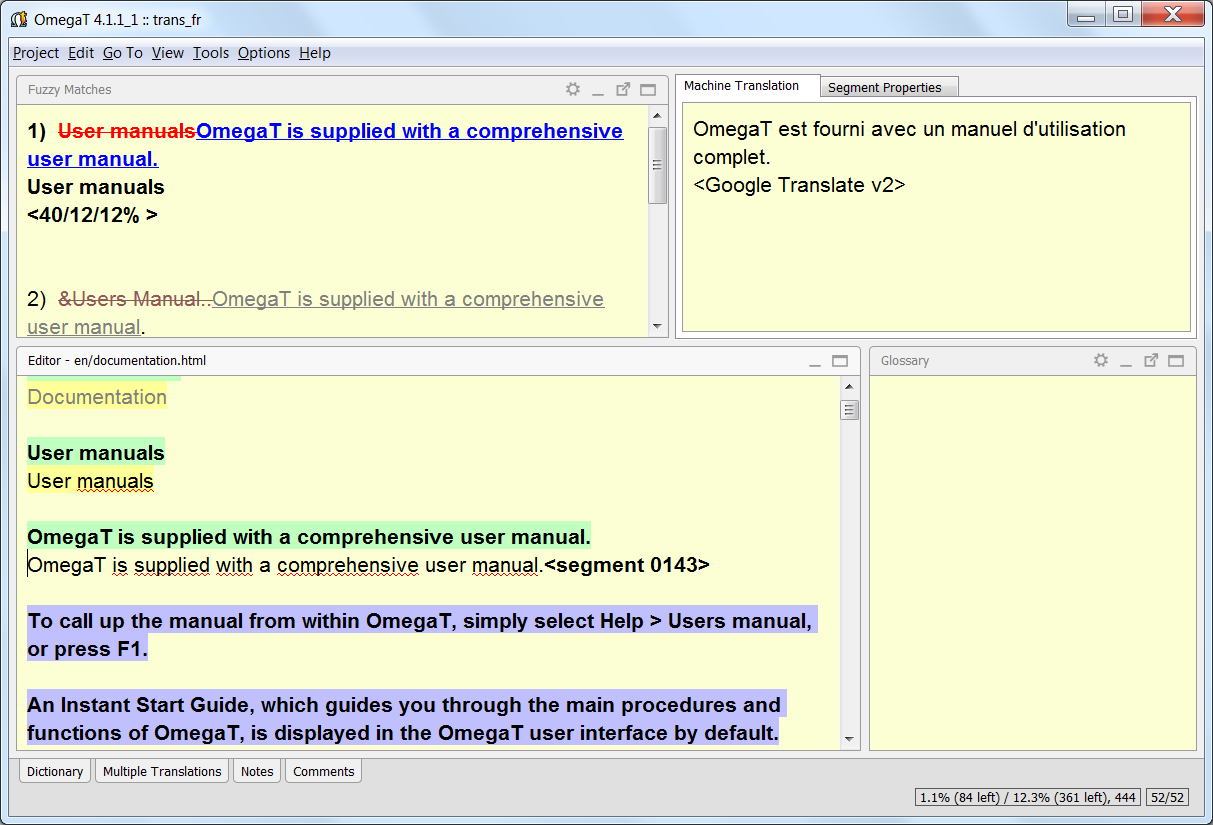
OmegaT is a translation memory application that works on Windows, macOS, Linux… It is a tool intended for professional translators. It does not translate for you! (Software that does this is called "machine translation". OmegaT can interface to some machine translation programs or Internet services)
OmegaT is free software. That means that users like you can download and use it with no restrictions. You are also free to copy it and pass it on to other people and even modify OmegaT to suit your own requirements. A more detailed explanation of free software can be found on the Free Software Foundation website.
Professional features
- Fuzzy matching
- Match propagation
- Simultaneous processing of multiple-file projects
- Simultaneous use of multiple translation memories
- User glossaries with recognition of inflected forms
Work with more than 30 file formats
- Microsoft Office Word, Excel, PowerPoint (2007 or later)
- XHTML and HTML
- OpenDocument Format (native file format for LibreOffice, Apache OpenOffice)
- MediaWiki (Wikipedia)
- Plain text
- …and around 30 other file formats
Powerful tools
- Unicode support: can be used with various alphabets and scripts
- Support for right-to-left languages
- Integral spelling checker that uses Hunspell dictionaries (same as in other software such as LibreOffice or Mozilla FireFox)
- Compatible with other translation memory applications via exchange formats such as TMX, TTX, TXML, XLIFF, SDLXLIFF
- Interface to machine translation/neural machine translation software/Web services
Download
OmegaT is available in many different versions in order to suit a range of user requirements.
To find the version most suitable for you, follow the link below to the Download Selector.
Alternatively, if you already know which version you wish to download, click on the button to have an overview of the different OmegaT versions available.
Decoys 2004 Isaidub Link [repack] «EXCLUSIVE × 2027»
Decoys are replicas or imitations designed to attract or distract. In a natural context, decoys are often used in hunting and wildlife observation to attract animals. For instance, fake owls or other predator decoys can be used to scare away pests from crops or gardens. In a more technological and strategic sense, decoys refer to devices or systems that mimic the characteristics of a valuable asset, such as a military target, to divert enemy fire or attention.
In various fields, including wildlife management, military operations, and even cybersecurity, the concept of decoys has been employed as a strategic tool to divert attention, mislead, or protect. One specific reference that has garnered interest is "Decoys 2004 Isaidub link," which seems to relate to a particular resource or discussion on decoys from that year. This article aims to explore the broader concept of decoys, their applications, and the strategic thinking behind their use. decoys 2004 isaidub link
The use of decoys hinges on deception and misdirection. By presenting a false target or image, decoys can protect actual assets, gather intelligence, or achieve a tactical advantage. The effectiveness of decoys depends on their realism, placement, and the context in which they are used. Decoys are replicas or imitations designed to attract
Decoys represent a fascinating strategy for diversion, protection, and intelligence gathering. From their use in wildlife management to military and cybersecurity applications, decoys play a critical role in strategic operations. While the specific reference to "Decoys 2004 Isaidub link" remains unclear without further context, it underscores the ongoing interest in how decoys can be utilized across different fields. As strategies evolve, so too does the concept and application of decoys, highlighting their versatility and enduring relevance. In a more technological and strategic sense, decoys