Automatisme Industriel Cours Pdf Verified Verified May 2026
RAPTOR is a flowchart-based programming environment, designed specifically to help students visualize their algorithms and avoid syntactic baggage. RAPTOR programs are created visually and executed visually by tracing the execution through the flowchart. Required syntax is kept to a minimum. Students prefer using flowcharts to express their algorithms, and are more successful creating algorithms using RAPTOR than using a traditional language or writing flowcharts without RAPTOR.
RAPTOR Web Edition (PREVIEW!)
Are you interested in running RAPTOR on Chromebooks, iPads, or just in a browser? Check out the pre-releasehere!. This is NOT fully tested. Send feedback via
RAPTOR Avalonia Edition (Multiplatform)
A Multiplatform version of RAPTOR is now available for Windows, Mac and Linux built on top of [Avalonia]!
See the downloads section below. Uses fonts from Noto Sans CJK for internationalization.
Key differences:
Only Intermediate mode (subcharts and procedures, no OO)
Will be able to load some files from Windows-only RAPTOR, but Windows-only will not load files from RAPTOR Multiplatform
Documentation will be [online] instead of distributed with the app.
RAPTOR image and Papers
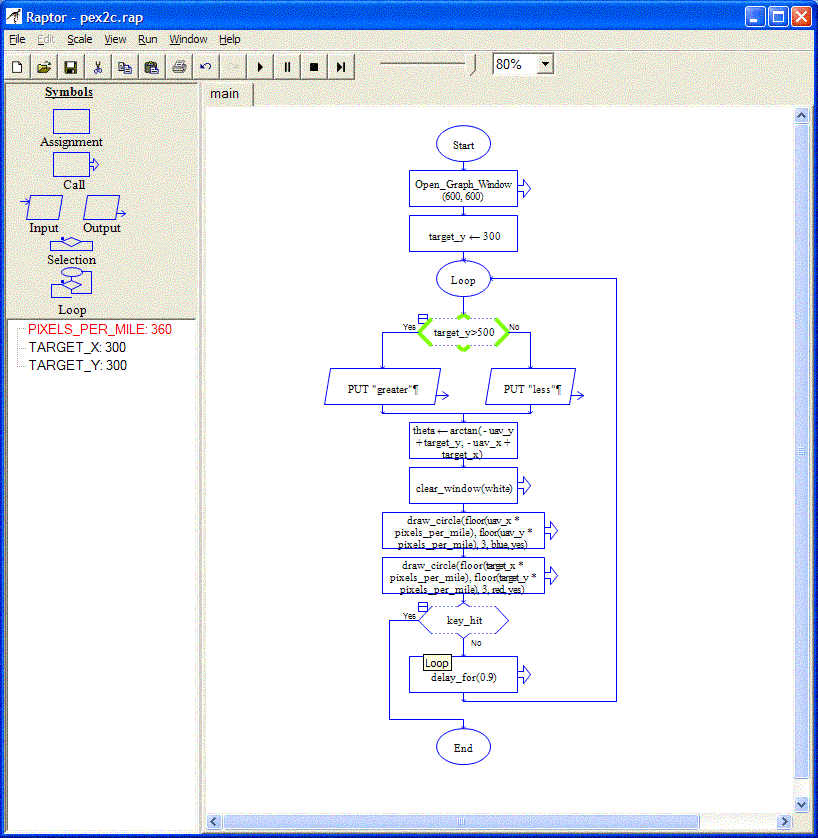
Figure 1 RAPTOR for Windows
Figure 2 RAPTOR Avalonia
Papers on RAPTOR application:
The use of RAPTOR in a general education course [view or download]
Global Chinese Conference on Computers in Education (GCCCE) 2011 [view or download]
The course also included interactive quizzes and assignments, which helped Emma verify her understanding of the material. She was pleased to find that the instructor was responsive to her questions and provided constructive feedback on her submissions.
One day, while searching for resources to deepen her knowledge, Emma stumbled upon an online course titled "Automatisme Industriel Cours PDF Verified". The course promised to provide a comprehensive introduction to industrial automation, covering topics such as control systems, robotics, and process control.
Emma had always been fascinated by the way machines and systems worked together to create efficient and productive industrial processes. As a young engineer, she had pursued a degree in Industrial Automation, eager to learn about the latest technologies and techniques used in the field.
From that day on, Emma was able to apply her skills and expertise to real-world projects, contributing to the development of more efficient and productive industrial processes. She remained grateful for the valuable resources and knowledge she had gained from the course, which had helped her become a skilled industrial automation engineer.
Intrigued, Emma decided to enroll in the course. She was impressed to find that the course materials were well-structured and easy to follow, with clear explanations and illustrations. The PDF files were neatly organized, making it easy for her to navigate and review the content.
Automatisme Industriel Cours Pdf Verified Verified May 2026
The course also included interactive quizzes and assignments, which helped Emma verify her understanding of the material. She was pleased to find that the instructor was responsive to her questions and provided constructive feedback on her submissions.
One day, while searching for resources to deepen her knowledge, Emma stumbled upon an online course titled "Automatisme Industriel Cours PDF Verified". The course promised to provide a comprehensive introduction to industrial automation, covering topics such as control systems, robotics, and process control. automatisme industriel cours pdf verified
Emma had always been fascinated by the way machines and systems worked together to create efficient and productive industrial processes. As a young engineer, she had pursued a degree in Industrial Automation, eager to learn about the latest technologies and techniques used in the field. The course promised to provide a comprehensive introduction
From that day on, Emma was able to apply her skills and expertise to real-world projects, contributing to the development of more efficient and productive industrial processes. She remained grateful for the valuable resources and knowledge she had gained from the course, which had helped her become a skilled industrial automation engineer. From that day on, Emma was able to
Intrigued, Emma decided to enroll in the course. She was impressed to find that the course materials were well-structured and easy to follow, with clear explanations and illustrations. The PDF files were neatly organized, making it easy for her to navigate and review the content.
Did you know RAPTOR has modes? By default, you start in Novice mode. Novice mode has a single global namespace for variables. Intermediate mode allows you to create procedures that have their own scope (introducing the notion of parameter passing and supports recursion). Object-Oriented mode is new (in the Summer 2009 version)
RAPTOR is Free!
RAPTOR is freely distributed as a service to the CS education community. RAPTOR was originally developed by and for the US Air Force Academy, but its use has spread and RAPTOR is now used for CS education in over 30 countries on at least 4 continents. Martin Carlisle is the primary maintainer, and is a professor at Texas A&M University.
Below handouts are by Elizabeth Drake, edited from Appendix D of her book, Prelude to Programming: Concepts and Design, 5th Edition, by Elizabeth Drake and Stewart Venit, Addison-Wesley, 2011. Linked here with author's permission.
Comments, suggestions, and bug reports are welcome. If you have a comment, suggestion or bug report, send an email to .
Forum
David Cox has put together a user forum at http://raptorflowchart.freeforums.org. This provides a place for users to exchange ideas, how tos, etc. Note however, that feedback for the author should be sent by email rather than posting on this forum.
The UML designer is based on NClass, an open-source UML Class Designer. NClass is licensed under the GNU General Public License. The rest of RAPTOR, by US Air Force policy, is public domain. Source is found here. RAPTOR is written in a combination of A# and C#. Unfortunately, I don't have the time to provide support on compilation issues